
Stop Saying “Good Job” and What to Do Instead

As parents, most of us use praise with the best intentions. We want to encourage our children, build their confidence, and reinforce positive behaviour. Saying things like “Good job!” or “Clever girl!” often feels natural and loving.
But when we look more closely at child development research—including Montessori philosophy—we begin to see that not all praise is equally helpful.
The key is understanding how to give praise that will encourage a growth mindset rather than a fixed mindset in children.
A famous study by psychologist Carol Dweck found that the way we praise children can significantly influence their motivation and resilience.
In her research, children who were praised for their effort (“You worked really hard!”) were more likely to take on challenges, persist through difficulty, and view mistakes as part of learning. In contrast, children praised for being smart (“You’re so clever!”) were more likely to avoid harder tasks and feel pressure to maintain that label.
The Potential Downsides of Empty or Product-Focused Praise
It Can Discourage Independent Play
If we get into the habit of offering constant empty praise like “good job” or “clever girl/boy” for every small action, children may begin to rely on our validation rather than their own sense of accomplishment. Instead of feeling satisfied from playing independently and enjoying what they’ve created, they might start seeking repeated reassurance, “Mummy, look at the tower I built!” or “Mummy, look at my drawing!”
This isn’t a problem in itself; it’s normal for children to want to share something they’ve created that they are genuinely proud of. It only becomes a problem if we have conditioned them to not be able to play independently because they require constant validation from us.
It Can Reduce Intrinsic Motivation
When children are constantly praised for outcomes (e.g. “You’re so smart!”, “This is incredible!”), they may begin to rely on external validation rather than internal motivation.
Instead of asking themselves, “Do I feel proud accomplishing this?” or “Did I enjoy this?” they might think, “What will people think about this?” “Will I get praised for doing this task?”
It Can Increase Performance Pressure
Praise focused on superficial traits (“Clever girl,” “You’re so smart”) can unintentionally create pressure to maintain that identity.
Children may think:
If I struggle, does that mean I’m not smart?
If I make a mistake, am I still clever?
This can contribute to anxiety around performance and fear of failure.
It Can Interrupt Focus
When a child is deeply concentrating, a “Good job!” can break their flow.
In Montessori philosophy, protecting concentration is essential. Learning happens most deeply during uninterrupted focus.
Sometimes the most respectful response is simply to observe quietly.
Alternatives to Saying “Good Job”
Here are practical, gentle alternatives you can use instead:
1. Don’t Say Anything
If your child is deeply focused and not even looking at you for connection, you can just not say anything at all. Silence can be powerful. Let their work stand on its own.
2. Say Thank You
If they’ve helped or contributed, you can thank them:
“Thank you for helping pack away the toys.”
“Thank you for passing me the spoon.”
3. Acknowledge the Process
Focus on effort rather than outcome:
“Wow, you worked on that drawing for a long time.”
“You kept trying even when it was tricky.”
4. Describe What You See
This is one of the most Montessori-aligned approaches. You are giving feedback by using positive and factual descriptions of the child’s actions.
“I see you stacked all the blocks.”
“You poured the water carefully.”
“You chose to use blue.”
It shows observation without judgment.
5. Ask About Their Experience
When a child runs to you to show you something that they’ve created, instead of just saying “Wow, that’s incredible, you are such a clever boy!”, encourage reflection:
“How did you come up with that idea?”
“What was the hardest part?”
“What are you proud of?”
This builds self-awareness and internal confidence in the child instead of making it about what you think of their work.
6. Acknowledge Character Traits
Instead of saying “You’re so smart,” focus on qualities demonstrated through behaviour and highlight values that we want our kids to have:
“You shared your cookie with your sister. That was very generous of you.”
“You showed bravery going down that steep slide.”
“You were so patient waiting for your turn.”
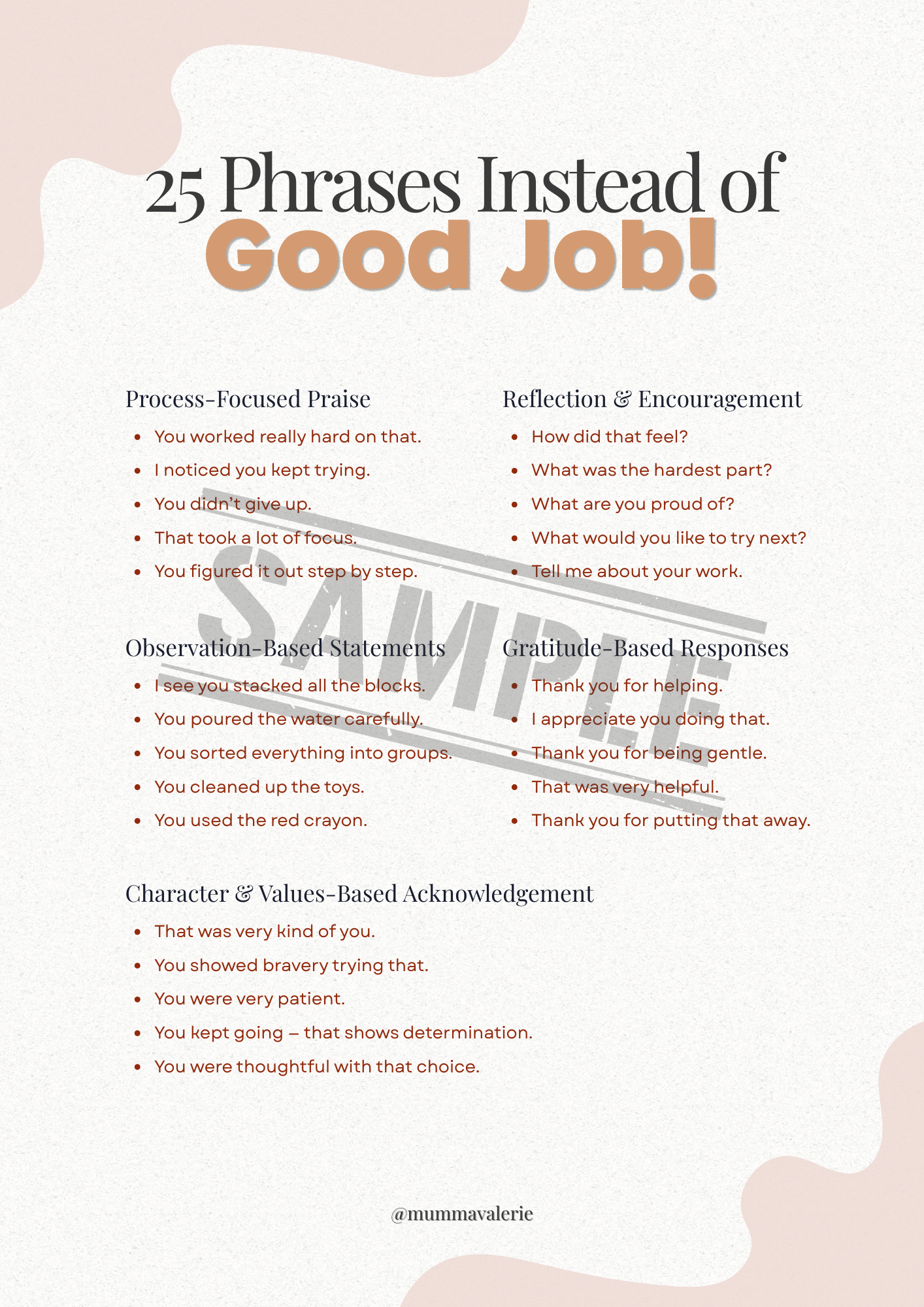
Here are 25 alternatives you can say instead of good job.
Download it by filling out the form below.
Why This Matters Long-Term
When children are supported with thoughtful feedback rather than constant evaluation:
They build intrinsic motivation
They develop resilience
They become comfortable with mistakes
They learn to trust their own judgement
They focus longer
They feel respected rather than judged